Ice Hotels
06
Hotels built from snow and ice that are rebuilt every winter and lost every spring.
Six hotels built from snow and ice, in Sweden, Canada, Norway, Switzerland, Romania and Austria. Every one of them is taken down by the thaw and built again the following winter, usually to a new plan, so a photograph from one season describes that season only.
What does not get in: ice bars without accommodation, single igloos rented as a novelty, and heated glass domes sold for watching the aurora, which are a different idea entirely.
09
Icehotel
Jukkasjärvi, Sweden · Ice Hotels
The first of them, built new from the Torne river every winter in Swedish Lapland since 1989.
Open
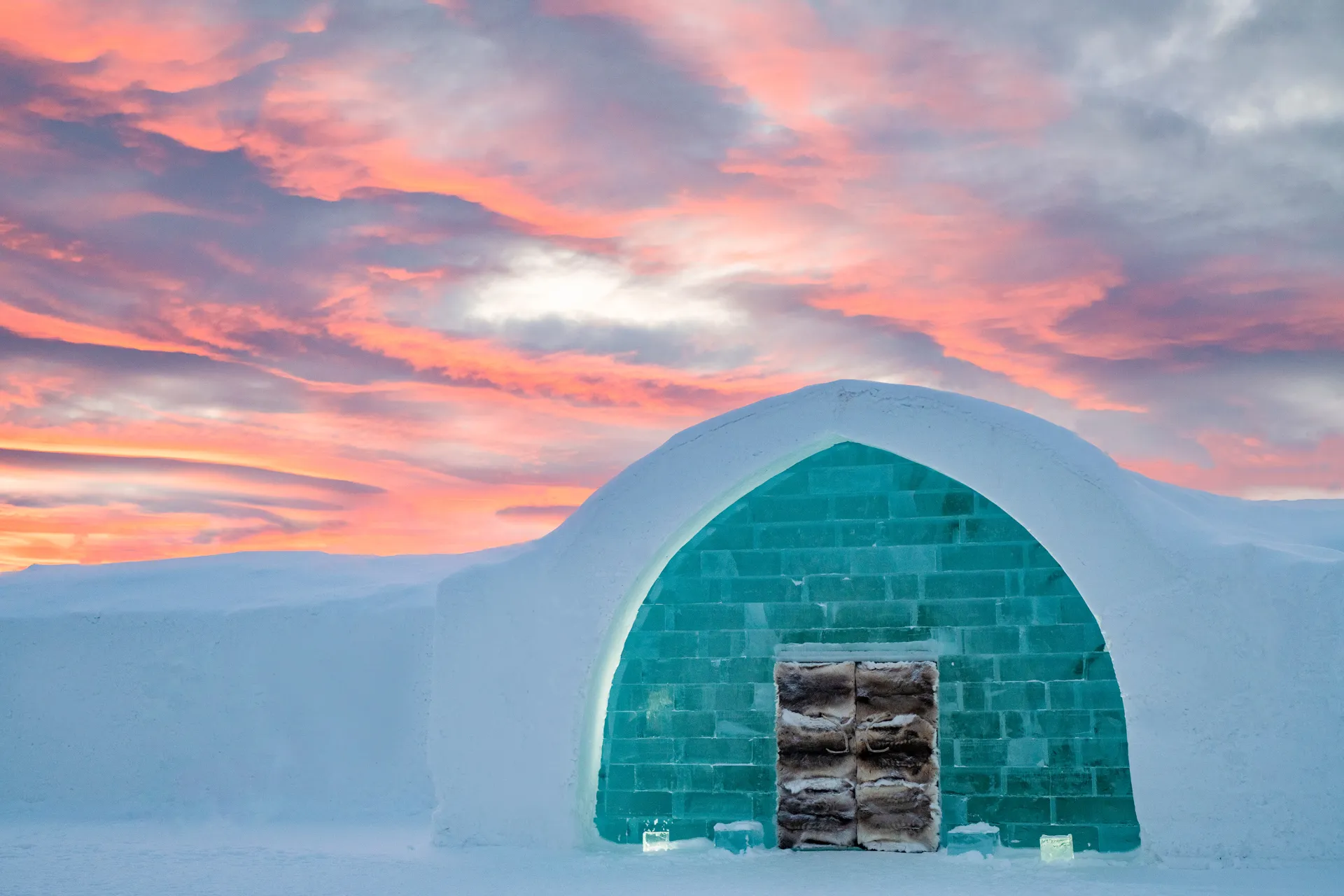
Icehotel, Jukkasjärvi, Sweden.
Icehotel began in 1989 in Jukkasjärvi, a village in Swedish Lapland north of the Arctic Circle, and every ice hotel that followed is answering it. The hotel is built each winter from ice cut out of the Torne river and from snow sprayed over steel forms, and each spring the river takes the material back.
That cycle is the design brief. Nothing is meant to survive, so nothing is designed to. Artists are invited to work on the individual suites, which means the hotel is a different building each year, with a different plan, different rooms and different carving. Photographs of one winter describe that winter only.
Sleeping in it is a specific experience rather than a comfortable one. The interior holds a few degrees below freezing regardless of the weather outside, guests sleep on ice beds under reindeer hides in insulated bags, and warm accommodation with proper bathrooms sits alongside for the rest of the stay.
Of the six hotels in this section, this is the one to read first. It set the pattern the others work within: cut, build, open for a season, and lose the whole thing to the thaw. Every hotel that came afterwards has had to decide how closely to follow that pattern.
10
Hôtel de Glace
Québec City, Canada · Ice Hotels
North America's ice hotel, redesigned and rebuilt from snow near Québec City every winter since 2001.
Open
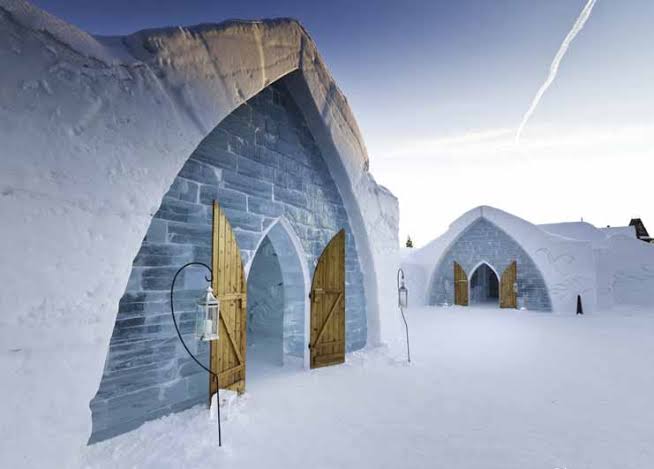
Hôtel de Glace, Québec City, Canada.
Hôtel de Glace opened in 2001 and is the ice hotel of North America. Like its Swedish predecessor it is built for a single season, but the emphasis here falls on snow rather than clear ice. Thick vaulted walls are formed over moulds, which gives the interiors their heavy, tunnelled feeling.
Every year the plan is drawn again. Rooms, corridors, the chapel and the bar move, and the carving that lines them is new work rather than a repeat of last winter. Guests who return find a building they have not been in before, standing on the same ground near Québec City.
The practical arrangement follows the pattern of the section. The ice building holds close to freezing whatever the weather does outside, sleeping is done in insulated bags on ice beds, and heated buildings nearby carry the bathrooms and the parts of a stay that cannot happen at minus five.
What sets it apart from Jukkasjärvi is proximity. This one sits within reach of a major city with an international airport, which makes it the most straightforward ice hotel in this section to add to an existing trip. Québec City in winter is a reason to travel on its own, and the ice hotel sits at the end of a short drive rather than at the end of a journey north.
11
Kirkenes Snowhotel
Kirkenes, Norway · Ice Hotels
A snow hotel in Norway's far north-east, near the Russian border, running each winter since 2006.
Open
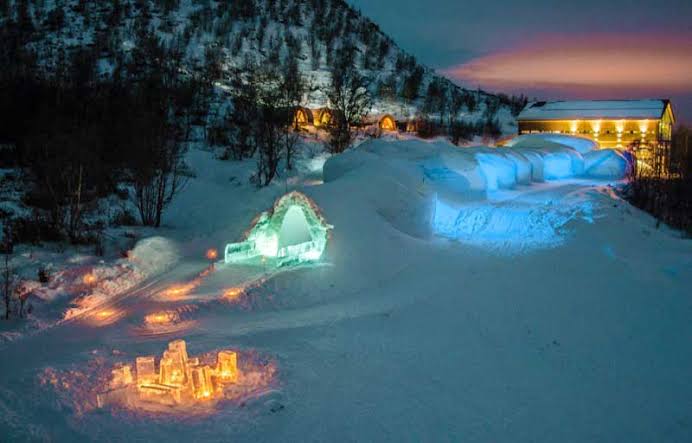
Kirkenes Snowhotel, Kirkenes, Norway.
Kirkenes sits at the top of Norway, closer to Murmansk than to Oslo, and the Snowhotel has been rebuilt there each winter since 2006. Of the six in this section it is the one furthest from an easy connection, and that remoteness is a large part of what it is selling.
The building is snow and ice, with carved rooms off a central corridor, held a few degrees below freezing throughout. Sleeping bags and hides do the work that heating cannot. Cabins with heat and bathrooms sit beside it, which is how nearly every hotel in this section is arranged.
The setting is what distinguishes it. This is a working corner of the Barents region rather than a resort valley: a fjord, a border, a port and a small town. The hotel runs husky and reindeer operations on the same site, and the darkness of the polar night is a genuine condition rather than an atmosphere.
Put beside Gstaad or Ötztal, this is the least alpine and the most northern of the six. If the appeal for you is latitude rather than altitude, it is the one to read closely. Getting here takes a day and at least one connection, and the town at the end of it is small, so the trip is the commitment rather than the night in the snow.
12
Iglu-Dorf
Gstaad, Switzerland · Ice Hotels
An igloo village rebuilt each winter at about two thousand metres above Gstaad in the Swiss Alps.
Open
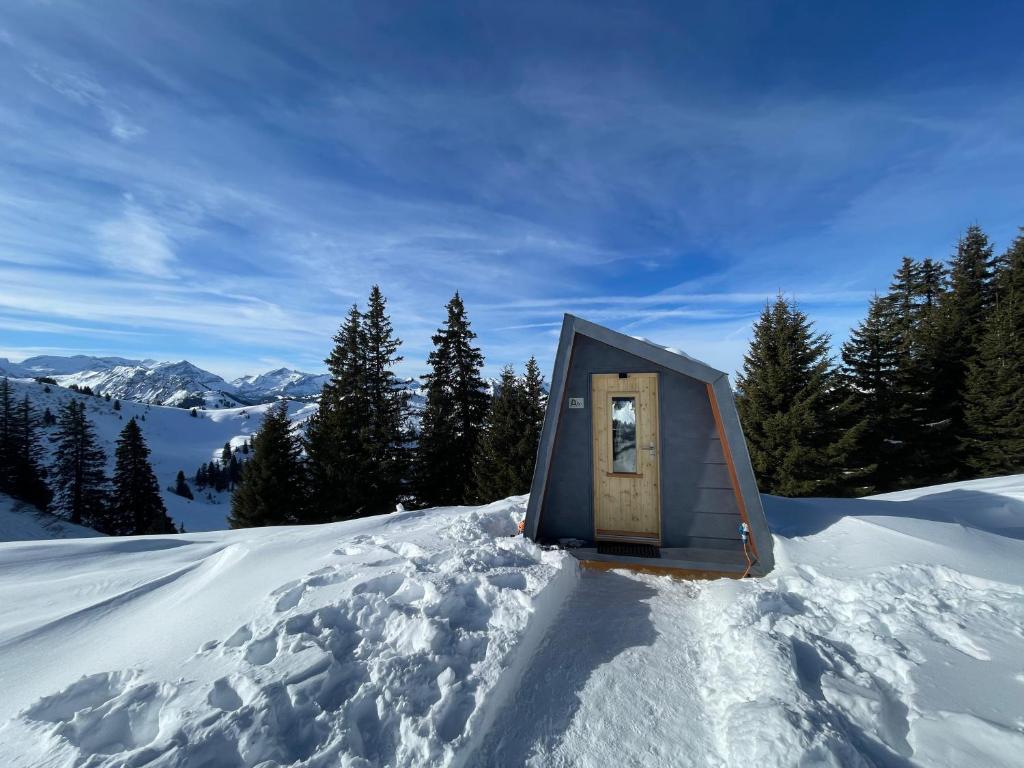
Iglu-Dorf, Gstaad, Switzerland.
Iglu-Dorf is an alpine reading of the format. Rather than one large building it is a village of linked igloos, built from packed snow at roughly two thousand metres above Gstaad and taken down by the melt. The domes are the structure, so the interiors are round, low and warmer in feel than a carved ice hall.
Altitude is the difference here. You arrive by lift rather than by road, which means the village sits above the treeline in a landscape of ski runs and peaks. The village opens onto that view directly, and the walk between domes happens outdoors in the snow.
Inside, the arrangement is familiar: insulated bags, hides, a temperature that holds a little below freezing, and a bar carved into the snow that does a good deal of the socialising. Some domes are carved as suites, others sleep several guests together, which makes it a more communal proposition than the Nordic hotels.
Among the six, this is the one closest to a night out in the mountains rather than a journey to the Arctic. It is also the easiest to reach from a European city, which is worth weighing against how much wilderness you actually want.
13
Hotel of Ice
Bâlea Lake, Romania · Ice Hotels
Built each winter since 2005 on a high glacial lake in Romania's Făgăraș mountains, reached by cable car.
Open
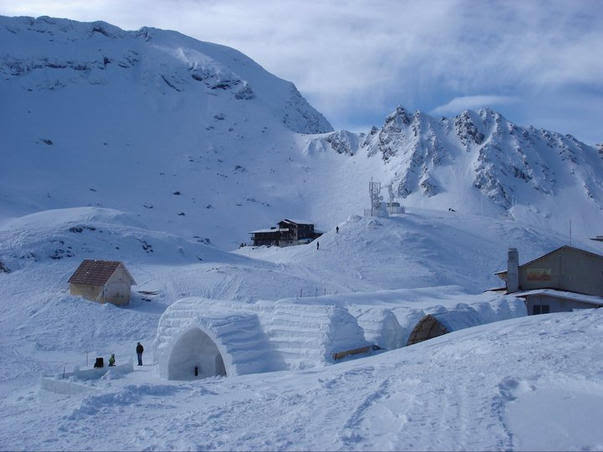
Hotel of Ice, Bâlea Lake, Romania.
The Hotel of Ice stands beside Bâlea Lake, a glacial lake high in the Făgăraș mountains of Romania, and has been rebuilt each winter since 2005. Blocks are cut from the frozen lake itself and used to build the walls, so the hotel is made from the water it sits on.
Access is part of the story. The road that reaches the lake in summer, the Transfăgărășan, closes under snow for months, so winter guests arrive by cable car from the valley. That single fact changes the feel of a stay: once you are up there, you are up there, and the weather decides the rest.
The building itself is modest by the standards of the section, a vaulted hall with rooms off it and a bar of carved ice, plus a small ice church that is rebuilt with the rest. Heated cabins nearby carry the facilities. Sleeping is on ice beds with hides and insulated bags, as everywhere here.
It is the least commercial of the six, and the most exposed. Cable cars stop in high wind, which is the practical risk you take on with it, and the mountains here are serious enough that the risk is not theoretical. Guests plan around the weather rather than the calendar.
14
Schneedorf Igloo
Ötztal, Austria · Ice Hotels
An Austrian snow village at around two thousand metres in the Ötztal, rebuilt from packed snow each winter.
Open
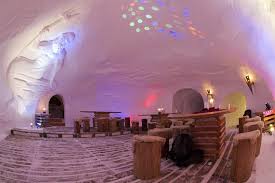
Schneedorf Igloo, Ötztal, Austria.
Schneedorf is the Austrian entry, a snow village built at about two thousand metres in the Ötztal valley and rebuilt every winter. The construction is packed snow shaped into domes and vaults, the same technique used in the Swiss village, applied to a larger and more spread-out plan.
The Ötztal is a working ski valley, so the hotel sits inside an existing mountain infrastructure of lifts, runs and villages rather than out on its own. Guests reach it by lift, walk in across the snow, and can be back down among restaurants and rooms with heating within the hour if the night turns out not to suit them.
Inside, the pattern of the section repeats: temperatures a few degrees below freezing whatever the valley is doing, insulated bags on ice or snow beds, hides for insulation, and a carved bar as the common room. Some domes are carved as private rooms and others are shared.
Read alongside Gstaad, this is the same idea in a different valley, and the two make a fair pair for anyone deciding which alpine version they want. Read alongside Kirkenes, it shows how much the latitude changes the experience. Two thousand metres in Tyrol and sea level in the Barents produce similar temperatures and entirely different nights.
Details change. Everything here is accurate to the best of our knowledge as at August 2026. All hotel names belong to their owners; we have no commercial relationship with any of them.
Where to go next
Every hotel in the guide sits in one of four sections, and the full list holds all eighteen in one place.