Home · All Hotels
All eighteen
The same lines as the section pages, gathered in one place. Group them the way you are actually planning: by the kind of hotel, or by where you will be.
18 hotels
Art Hotels · 06
01
Art Series — The Olsen
South Yarra, Melbourne, VIC · Art Hotels
An Art Series hotel in South Yarra named for the painter John Olsen, whose work fills it.
Open
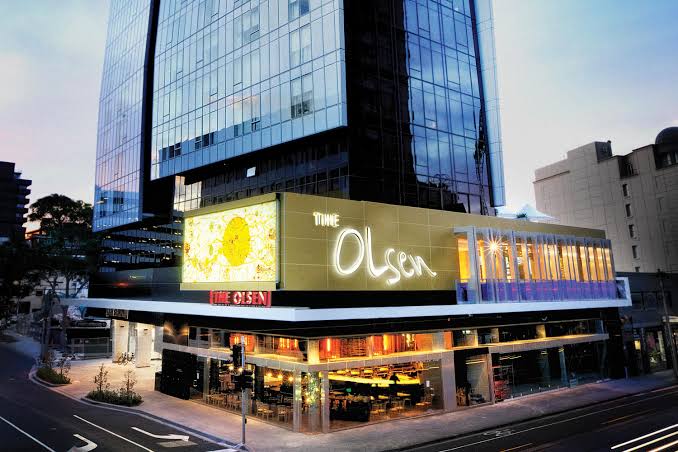
Art Series — The Olsen, South Yarra, Melbourne, VIC.
The Olsen belongs to the Art Series group, and the idea behind that group is simple. Each hotel takes one Australian artist and builds itself around the work. Here the artist is John Olsen, a painter who spent a career on water, birds and the dry inland, and whose lines do not sit quietly on a wall.
The hotel stands on Chapel Street in South Yarra, which is a shopping street with trams down the middle and a long line of cafes. That matters more than it sounds. You walk out of a building hung with paintings and straight into the ordinary noise of Melbourne, and the two things sharpen each other.
Inside, the work is not confined to a gallery corner. Prints and originals run through the corridors and the rooms, so guests meet the collection on the way to the lift rather than by making a decision to look. Suites are the format the hotel is known for, many with kitchen benches and glass-fronted balconies.
Of the six hotels in this section, The Olsen is the most urban and the easiest to reach without planning. It is the one we would send a first-time visitor to, because the hotel explains its own premise within about a minute of arrival.
02
Art Series — The Johnson
Spring Hill, Brisbane, QLD · Art Hotels
The Brisbane hotel in the Art Series group, given over to the bright abstract work of Michael Johnson.
Open
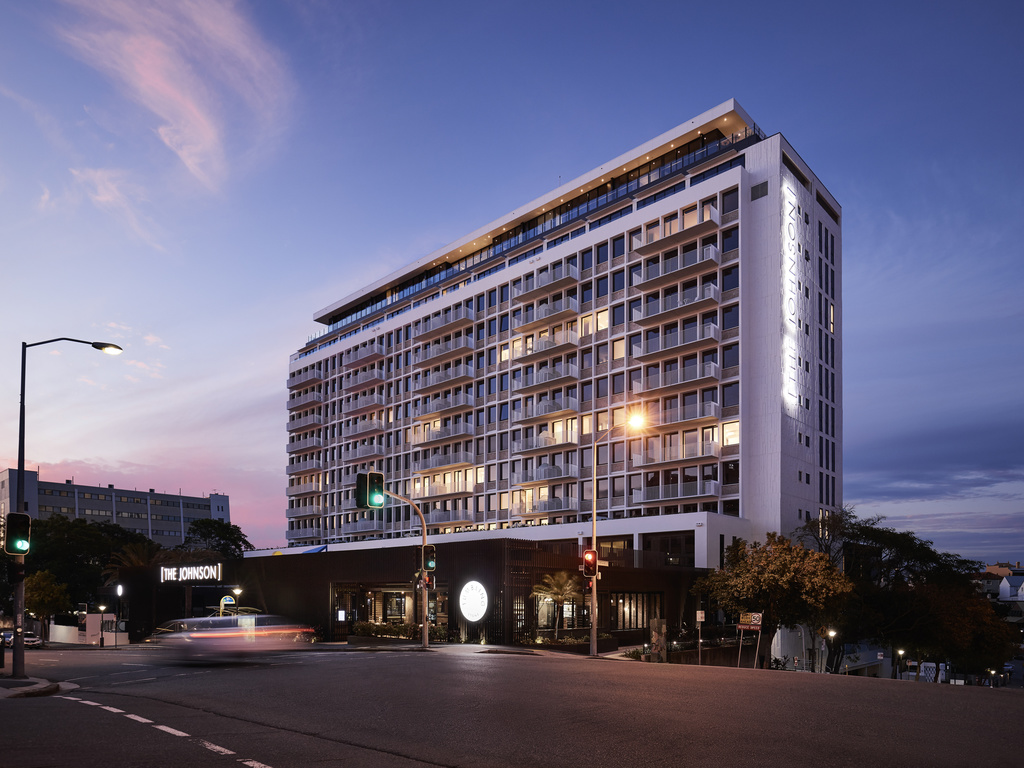
Art Series — The Johnson, Spring Hill, Brisbane, QLD.
The Johnson takes the same premise as the other Art Series hotels and hands it to Michael Johnson, an Australian abstract painter whose colour arrives at full strength. Where a hotel that leans on landscape photography stays polite, this one does not. The work is loud in the way abstraction can be loud, and the interiors are built to carry it.
The hotel sits in Spring Hill, on the rise just north of the Brisbane CBD. Spring Hill is a mixed suburb of old workers cottages, medical rooms and apartment blocks, and the hotel reads as part of that mix rather than as a landmark. The city centre is a walk downhill, which is easier in one direction than the other.
Rooms and apartments run to kitchen benches and laundry facilities, which tells you who stays here. This is a hotel for people in Brisbane for a week, not a night, and the art is there to keep a longer stay from turning into a serviced apartment with a view of a car park.
Read against The Olsen, the difference is temperature. Melbourne gets a painter of water and drought; Brisbane gets pure colour, in a city where the light is already doing most of the work outdoors.
03
Art Series — The Watson
Walkerville, Adelaide, SA · Art Hotels
An Adelaide hotel in the Art Series group, named for the Western Desert painter Tommy Watson.
Open
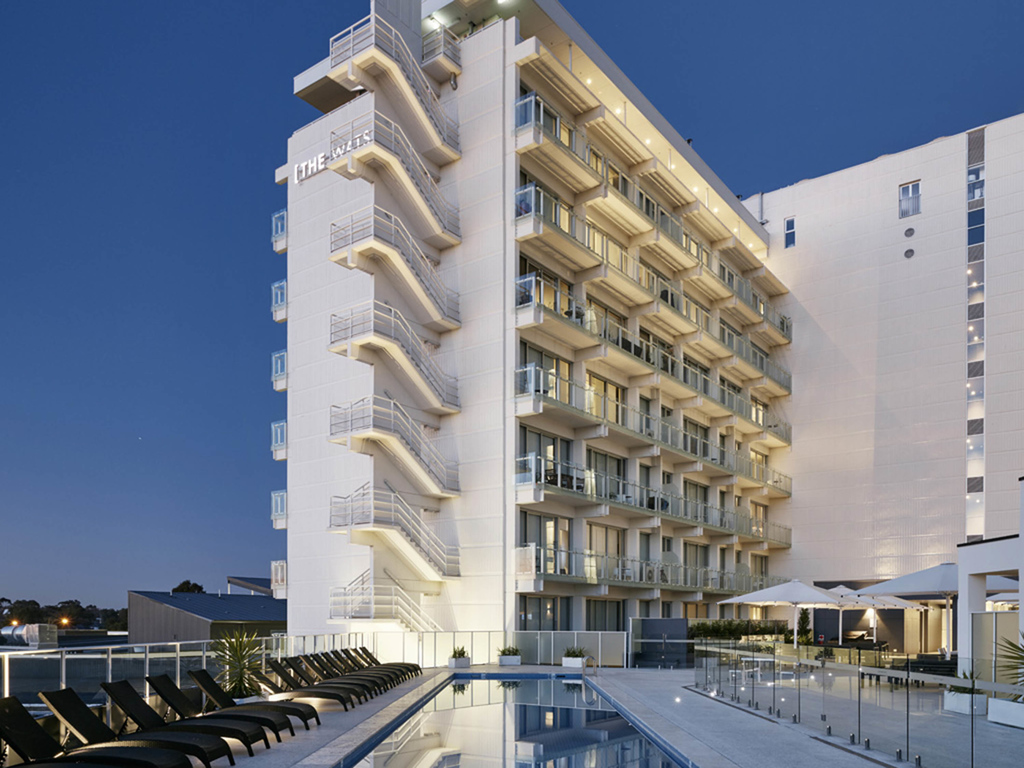
Art Series — The Watson, Walkerville, Adelaide, SA.
Name and operator last checked August 2026
The Watson is the Adelaide entry in the Art Series group, and it is named for Tommy Watson, a Pitjantjatjara painter from the Western Desert whose canvases work in dense, layered colour. Placing that work in a suburban hotel north of the Adelaide parklands is a decision, and the hotel is more interesting for having made it.
The address is Walkerville, which sits just beyond the parklands ring rather than in the city grid. Adelaide is small enough that this is not a problem, and the setting is quieter than a CBD hotel would be. The hotel is a tall modern block among low streets, so the upper floors look a long way out.
The format follows the group: apartment-style rooms with kitchen benches, reproductions and originals through the public spaces, and a bar and dining room on the ground floor. Guests who never intend to look at a painting still walk past several a day.
Within this section, The Watson is the one that most clearly tests the Art Series idea. The other five hotels build around European or urban Australian traditions. This one builds around desert painting, in a state where the desert starts a few hours up the road, and the pairing holds.
04
QT Sydney
Sydney CBD, NSW · Art Hotels
A hotel threaded through the State Theatre and the old Gowings department store on Market Street.
Open
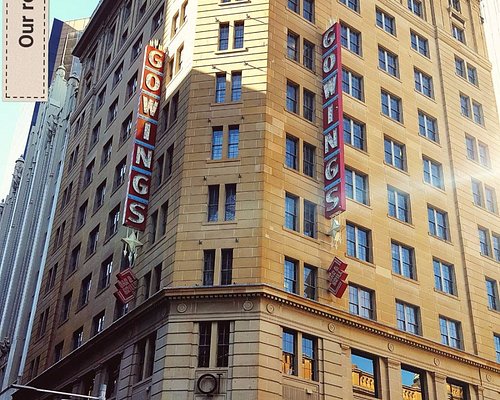
QT Sydney, Sydney CBD, NSW.
Name and operator last checked August 2026
QT Sydney occupies two buildings that were never meant to be a hotel. One is the State Theatre, a 1929 picture palace of gilt and marble that still runs as a theatre. The other is the Gowings building, a department store that dressed Sydney men for the better part of a century. The hotel runs through both.
That history is the whole point. Corridors change direction because the two buildings never lined up, floor levels shift, and rooms sit in shapes that no architect would draw from scratch. Some look into the old store's light wells. The result is a hotel where the plan has to be discovered rather than understood at the door.
The interiors are deliberately theatrical, which suits a building that shares a wall with a working stage. There is a restaurant, a bar upstairs and a barber shop on the ground floor, all leaning into the same idea. Guests turn up for the rooms and stay downstairs longer than they planned.
Among the six art hotels here, this is the one where the art is the building itself rather than a named painter. It is also the most central: Market Street puts the Queen Victoria Building, the Pitt Street malls and the harbour within a short walk.
05
COMO The Treasury
Perth, WA · Art Hotels
A hotel inside Perth's restored nineteenth-century State Buildings, where the colony once kept its treasury.
Open
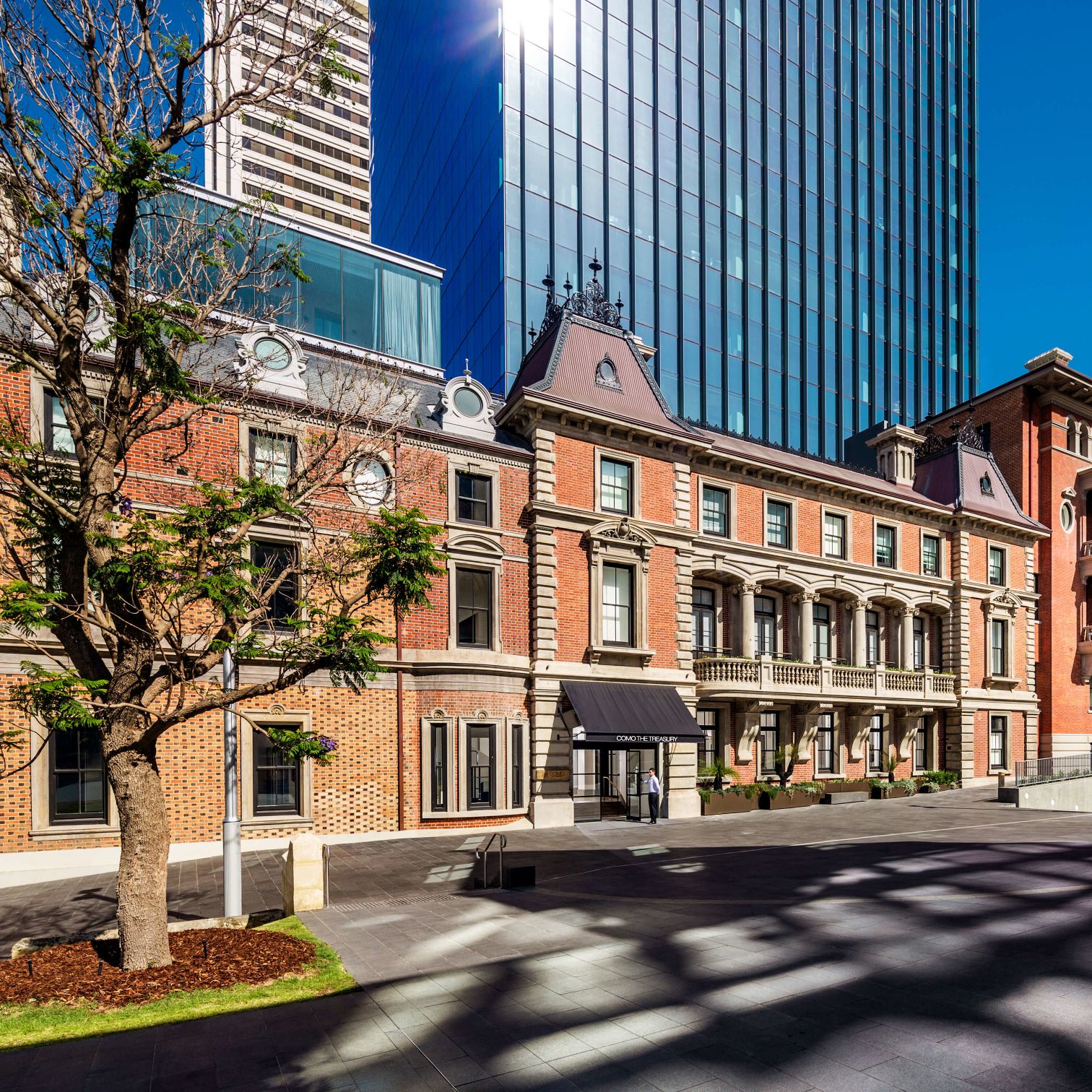
COMO The Treasury, Perth, WA.
Name and operator last checked August 2026
The State Buildings on the corner of Barrack Street and St Georges Terrace were the administrative centre of the colony of Western Australia. The treasury sat here, along with the post office and the lands department. The buildings stood mostly empty for years before the restoration that turned part of them into this hotel.
What that gives the hotel is a plan it did not choose. Rooms are set behind the original windows, which are tall and unevenly spaced because they were cut for offices. Ceilings are high for the same reason. The corridors still run where the office corridors ran, and the stonework in the public rooms was left to look its age.
The ground floor was handed to restaurants, bars and a wine shop that anyone can walk into, so the building went back to being a place the city passes through rather than a lobby with a security desk. The hotel occupies the upper levels above that traffic.
This is our Western Australian entry, and it is the one nearest home. Perth does not have many nineteenth-century buildings left standing in use, which is a large part of why this hotel is in the section at all.
06
Saffire Freycinet
Coles Bay, TAS · Art Hotels
A low Tasmanian lodge on Great Oyster Bay, facing the granite peaks of the Hazards across the water.
Open
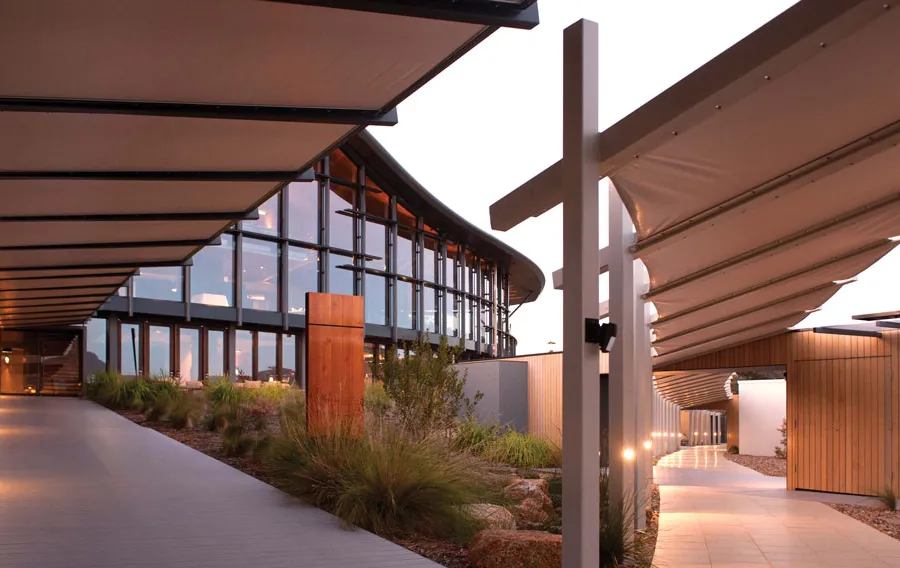
Saffire Freycinet, Coles Bay, TAS.
Name and operator last checked August 2026
Saffire Freycinet is the only entry in this section that is not in a city, and the only one where the view does more work than the interior. The lodge sits above Great Oyster Bay at Coles Bay, on the east coast of Tasmania, looking across the water at the Hazards, the pink granite range that closes off the Freycinet peninsula.
The building answers that view rather than competing with it. It is long, low and curved, timber-lined, with the main pavilion given over to glass so the range is in front of you from most of the public rooms. Suites are separate and spread along the slope, so the lodge reads as a settlement rather than a block.
The reason it belongs in a section about art hotels is the same reason The Treasury does. The design here is the work being shown. Tasmanian timbers, a roofline drawn against the range, and a plan that keeps the bay in sight from almost everywhere are the argument the building makes.
It is also the hardest of the six to reach, and the most seasonal in feeling. That is worth knowing before you plan around it, because Coles Bay is a drive from anywhere with an airport.
Capsule Hotels · 02
07
The Capsule Hotel
Sydney, NSW · Capsule Hotels
A central Sydney capsule hotel that sells a berth and shared bathrooms, and is honest about it.
Open
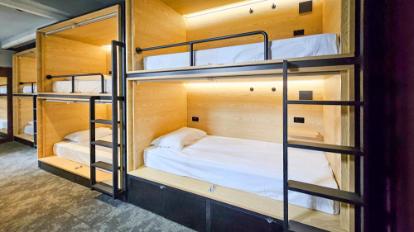
The Capsule Hotel, Sydney, NSW.
A capsule hotel sells a bed in a moulded berth, not a room, and this one does not pretend otherwise. Capsules are stacked along corridors, each closing with a screen or a door rather than a wall, with a light, a socket and enough headroom to sit up. Bathrooms are shared and down the hall.
The format came from Japan, where it solved a specific problem: a bed near a station for someone who missed a train. Sydney has borrowed the format for a different set of guests, mostly people who want a city-centre address for a night without the price of a room they will only sleep in.
What makes it worth listing is the discipline of the design. Everything is worked out to the centimetre, because there is no spare centimetre. Storage sits under or beside the berth, the corridors are narrow by design, and the common area does the work a lobby and a lounge would do in a larger hotel.
It is the smaller idea of the two hotels in this section, and the more traditional reading of the format. If you have stayed in a capsule in Osaka, you will recognise the plan immediately. What has changed in the crossing is the guest: fewer commuters, more travellers with a bag and an early flight.
08
The Pod Sydney
Sydney, NSW · Capsule Hotels
The second Sydney capsule hotel, a pod format for one night in the city between flights or trains.
Open
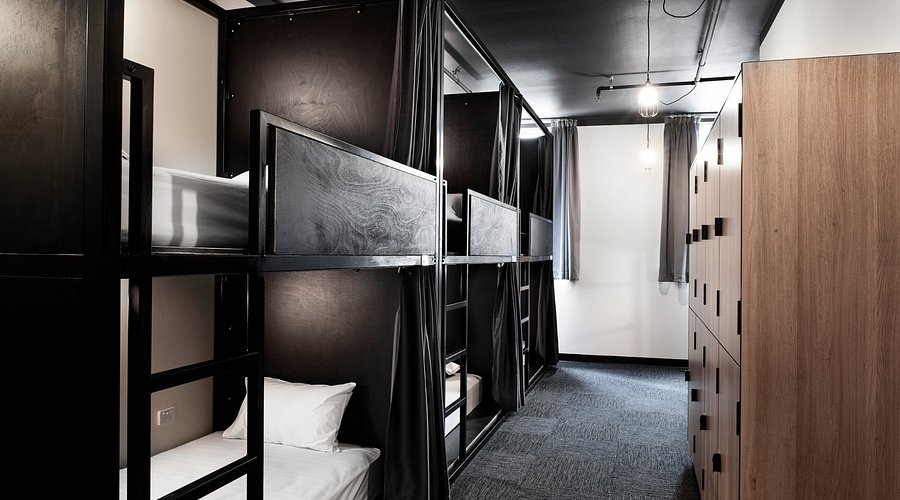
The Pod Sydney, Sydney, NSW.
The Pod Sydney takes the same starting point as its neighbour in this section and reads it slightly differently. The unit is a pod rather than a bunk: an enclosed sleeping space with its own light and power, arranged in rows, with bathrooms and a common area shared by the floor.
The appeal is location for a night. A capsule hotel earns its place by being in the middle of a city where a room costs what a room costs, and by asking guests to give up everything except the bed and the address. Everything the format removes is something you would not use between eleven at night and seven in the morning.
Because there are no windows in most capsules, the lighting inside does the work of morning and evening, and that is worth knowing if you sleep badly in the dark. Guests who need to work, spread out or keep unusual hours are better served elsewhere, and the hotel does not argue otherwise.
Two hotels is a short section. We would rather run a short section than pad it with hostels, which are a different format with different rules, and there are only a handful of true capsule hotels in Australia to describe.
Casino Hotels · 04
15
Montreal Casino & Hotel
Île Notre-Dame, Montréal, Québec · Casino Hotels
A hotel and casino in the sculptural Expo 67 pavilions on an island in the St Lawrence River.
Open
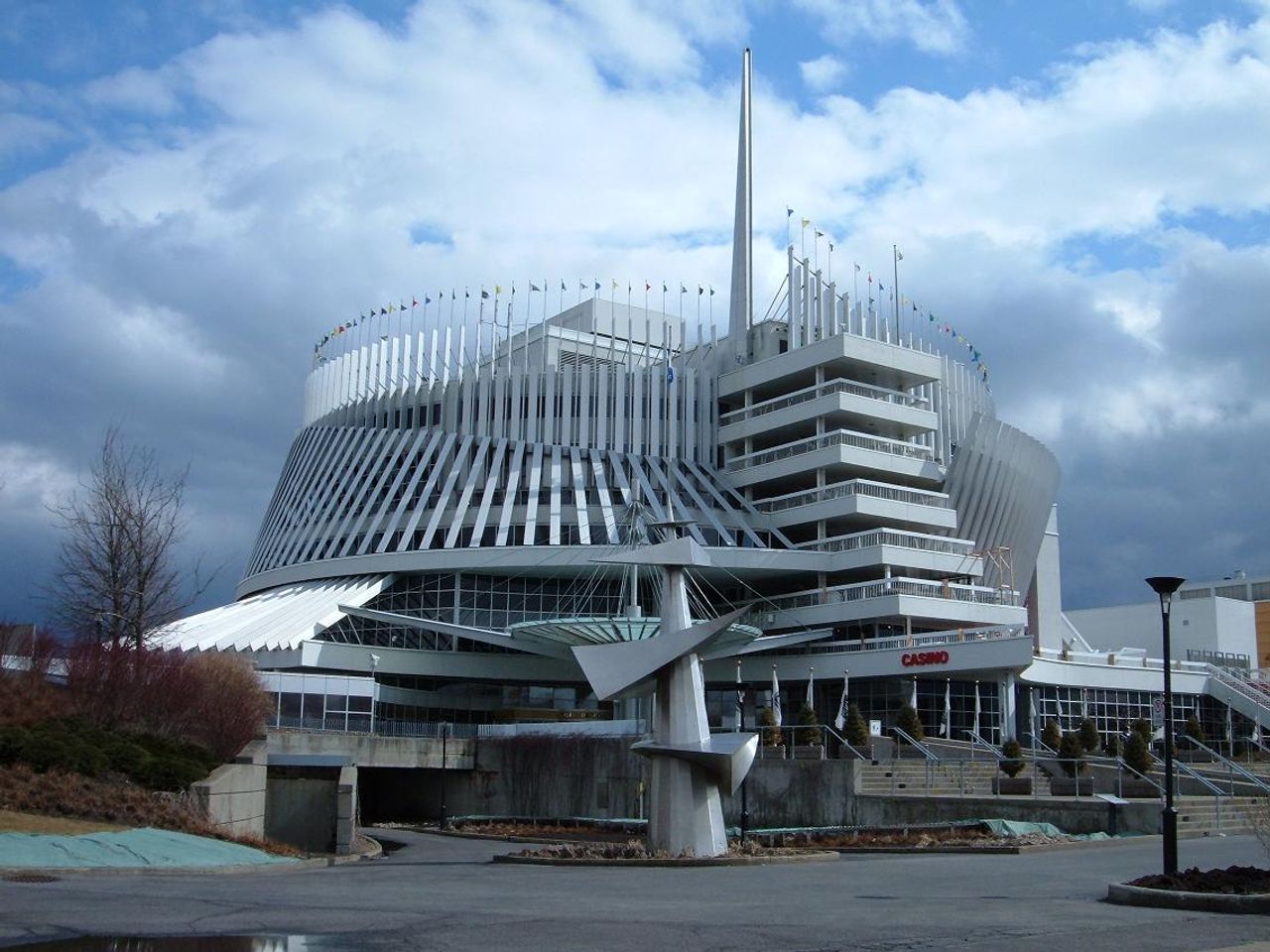
Montreal Casino & Hotel, Île Notre-Dame, Montréal, Québec.
This one exists because of a world's fair. The buildings on Île Notre-Dame were the French and Québec pavilions of Expo 67, and they were designed to be looked at: angular, layered, more sculpture than shed. Rather than being demolished when the fair closed, they were kept and eventually converted.
The conversion is the interesting part. A pavilion built to move crowds through in twenty minutes had to become a building people stay inside for an evening, and the levels stacked inside the original volume are what came of that. You move up and down through the building far more than you move across it.
There are restaurants with a serious kitchen behind them, and a regular programme of live music through the year. The upper levels look back across the water at the Montréal skyline, which is the view the pavilions were given in the first place.
The setting is a park island in the St Lawrence, shared with the rowing basin and the racing circuit left over from the same era. It is green, flat and open, and it feels a long way from a downtown hotel even though the city is directly in front of you. Few hotels anywhere have a stranger origin, and fewer still have kept the shape of the building they started as.
16
Fallsview Casino Resort
Niagara Falls, Ontario · Casino Hotels
An early two-thousands resort set on the cliff above the falls, with rooms and restaurants facing the water.
Open
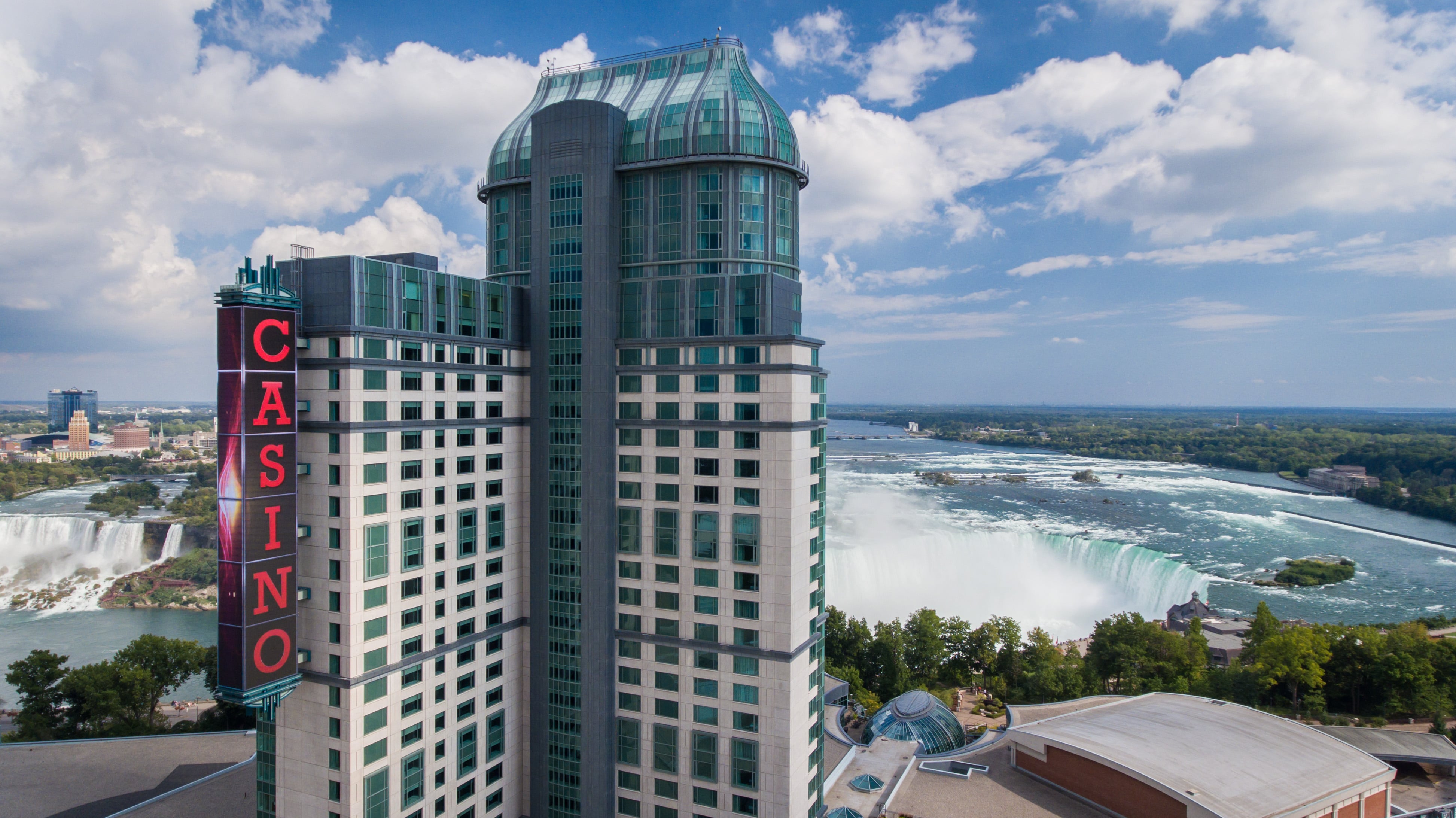
Fallsview Casino Resort, Niagara Falls, Ontario.
Fallsview opened in the early two-thousands on the escarpment directly above Niagara Falls, and the site is the whole design argument. The building is cut into the cliff, so what would be a basement anywhere else opens onto the gorge, and the public rooms are arranged along the side that faces the water.
That produces a hotel with a strong front and a plain back. Restaurants and lounges take the view, guest rooms above them are graded by whether they face the falls or the town behind, and the interior circulation runs parallel to the cliff rather than around a courtyard. It is a simple plan carried out at large scale.
The resort carries a theatre that books touring names through the year, a spa, and a range of restaurants from casual rooms to full dining. In practice it works as the indoor half of a Niagara stay, with the falls and the parkland doing the other half a few minutes downhill.
Niagara Falls is a tourist town and does not hide it. The resort belongs to that town rather than standing apart from it, and it is the busiest of the four hotels in this section. Anyone hoping for a quiet weekend is better served by the other three.
17
River Rock Casino Resort
Richmond, British Columbia · Casino Hotels
A waterfront resort in Richmond outside Vancouver, with its own marina, a show theatre and a spa.
Open
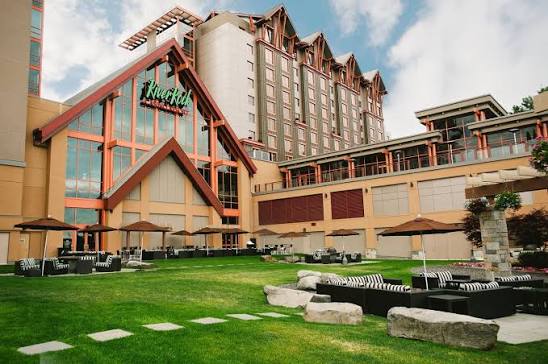
River Rock Casino Resort, Richmond, British Columbia.
River Rock sits on the water at Richmond, on the arm of the Fraser River that runs out past Vancouver's airport. The resort has its own marina, which is unusual for a hotel of this kind, and the waterfront frontage gives it a horizontal, low-slung shape rather than a tower.
Richmond matters to the description. It is a city in its own right, with one of the strongest concentrations of Chinese and other Asian restaurants in North America, and the resort sits inside that food culture rather than importing one. Guests who eat out are better served in the surrounding blocks than in most hotel districts.
The resort carries a show theatre used for touring music and comedy, a spa, and several restaurants across the site. The rooms above are ordinary in the good sense: quiet, generous and largely given over to the view across the water and the flats.
The airport is close, which is convenient and audible. This is the most urban of the four hotels in this section, and the one where the surrounding city gives you the most reason to leave the building. It is also the simplest to work into the start or the end of a trip, since the rail link runs from the terminal to the door in minutes.
18
Casino Rama Resort
Rama, Ontario · Casino Hotels
A lakeside Ontario resort on Chippewas of Rama First Nation land, with a large concert hall and golf.
Open
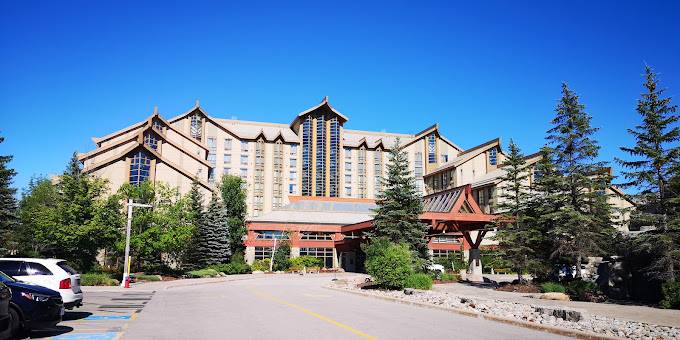
Casino Rama Resort, Rama, Ontario.
Casino Rama stands on the lands of the Chippewas of Rama First Nation, beside Lake Couchiching in central Ontario. That ownership is the first thing to say about it, because the resort was developed on and for those lands, and it is the reason a building of this size sits in a rural township rather than in a city.
The site is lake country. Couchiching and Simcoe are cottage lakes, and the landscape around the resort is water, low bush and golf rather than streets. The buildings spread horizontally across the ground, with the accommodation set apart from the entertainment side.
The concert hall is the part that draws people from a distance. It is large, it books touring acts through the year, and a night there is what fills the rooms upstairs. Alongside it are restaurants across several formats and a spa, arranged so that the resort works as a self-contained weekend.
Of the four hotels in this section, this is the one most tied to its landscape and the least tied to a city. It is also the one where the drive is part of the plan rather than an inconvenience. The route north out of Toronto through the lakes is the beginning of the stay, not a delay before it.
Ice Hotels · 06
09
Icehotel
Jukkasjärvi, Sweden · Ice Hotels
The first of them, built new from the Torne river every winter in Swedish Lapland since 1989.
Open
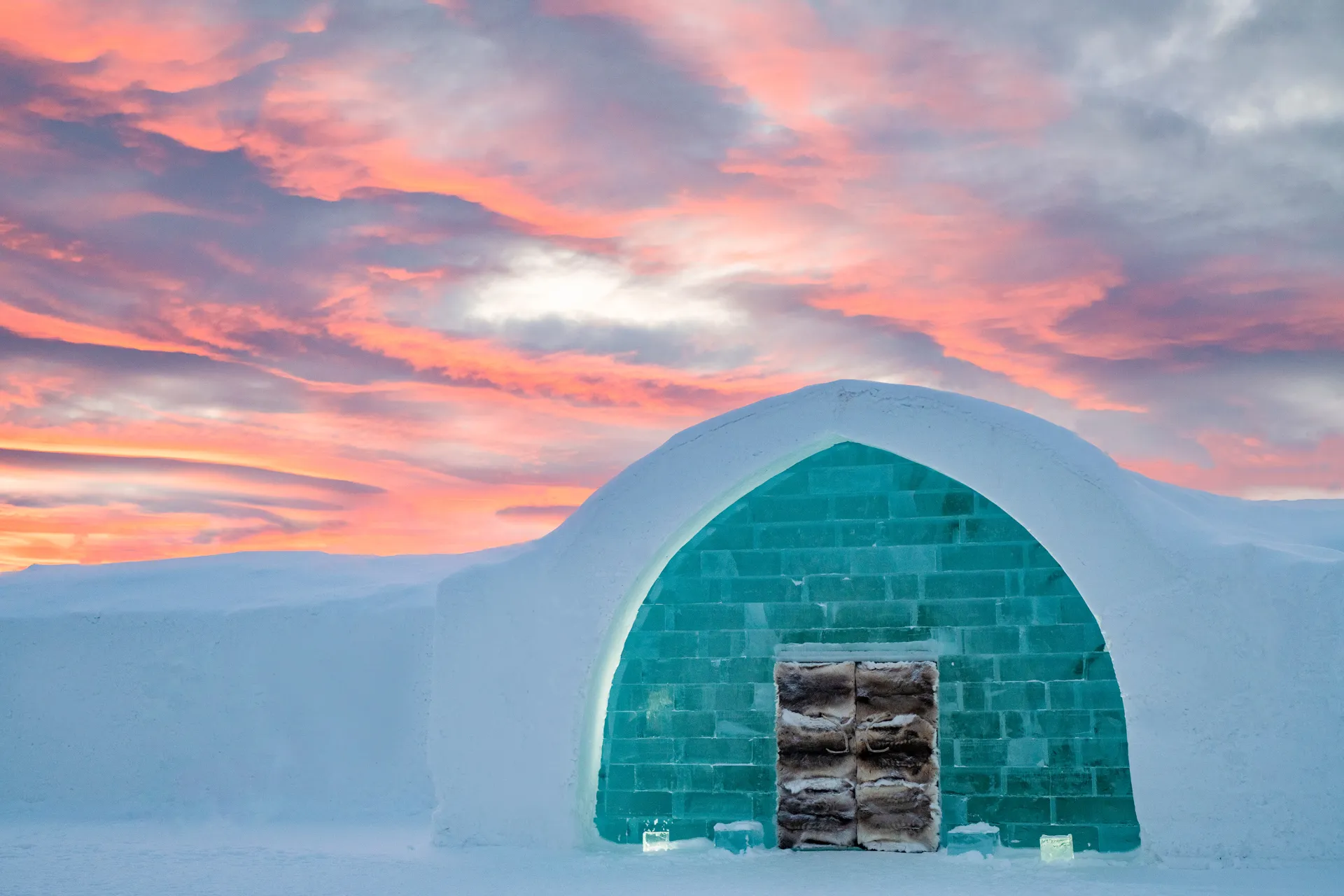
Icehotel, Jukkasjärvi, Sweden.
Icehotel began in 1989 in Jukkasjärvi, a village in Swedish Lapland north of the Arctic Circle, and every ice hotel that followed is answering it. The hotel is built each winter from ice cut out of the Torne river and from snow sprayed over steel forms, and each spring the river takes the material back.
That cycle is the design brief. Nothing is meant to survive, so nothing is designed to. Artists are invited to work on the individual suites, which means the hotel is a different building each year, with a different plan, different rooms and different carving. Photographs of one winter describe that winter only.
Sleeping in it is a specific experience rather than a comfortable one. The interior holds a few degrees below freezing regardless of the weather outside, guests sleep on ice beds under reindeer hides in insulated bags, and warm accommodation with proper bathrooms sits alongside for the rest of the stay.
Of the six hotels in this section, this is the one to read first. It set the pattern the others work within: cut, build, open for a season, and lose the whole thing to the thaw. Every hotel that came afterwards has had to decide how closely to follow that pattern.
10
Hôtel de Glace
Québec City, Canada · Ice Hotels
North America's ice hotel, redesigned and rebuilt from snow near Québec City every winter since 2001.
Open
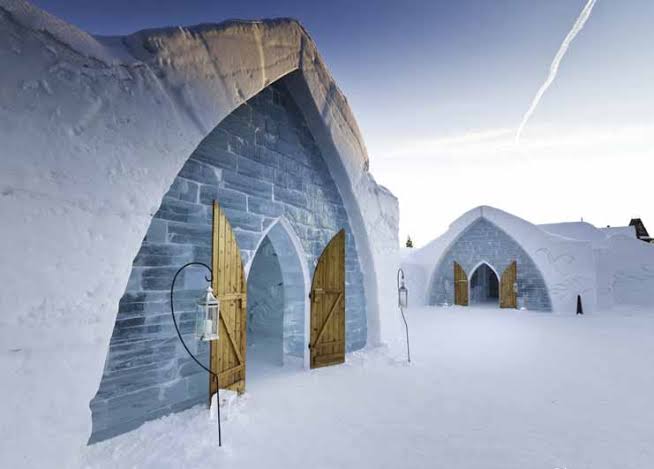
Hôtel de Glace, Québec City, Canada.
Hôtel de Glace opened in 2001 and is the ice hotel of North America. Like its Swedish predecessor it is built for a single season, but the emphasis here falls on snow rather than clear ice. Thick vaulted walls are formed over moulds, which gives the interiors their heavy, tunnelled feeling.
Every year the plan is drawn again. Rooms, corridors, the chapel and the bar move, and the carving that lines them is new work rather than a repeat of last winter. Guests who return find a building they have not been in before, standing on the same ground near Québec City.
The practical arrangement follows the pattern of the section. The ice building holds close to freezing whatever the weather does outside, sleeping is done in insulated bags on ice beds, and heated buildings nearby carry the bathrooms and the parts of a stay that cannot happen at minus five.
What sets it apart from Jukkasjärvi is proximity. This one sits within reach of a major city with an international airport, which makes it the most straightforward ice hotel in this section to add to an existing trip. Québec City in winter is a reason to travel on its own, and the ice hotel sits at the end of a short drive rather than at the end of a journey north.
11
Kirkenes Snowhotel
Kirkenes, Norway · Ice Hotels
A snow hotel in Norway's far north-east, near the Russian border, running each winter since 2006.
Open
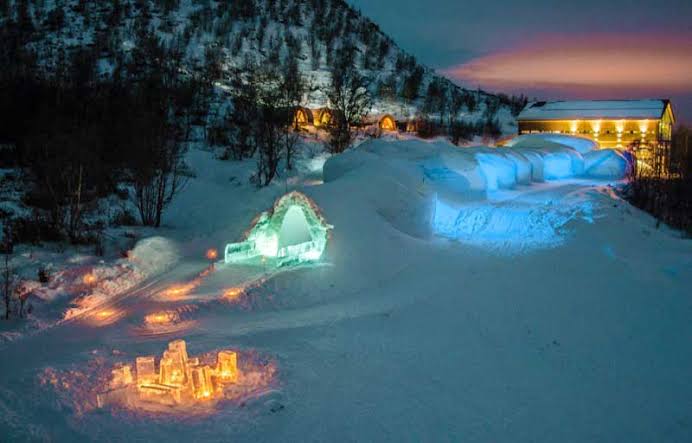
Kirkenes Snowhotel, Kirkenes, Norway.
Kirkenes sits at the top of Norway, closer to Murmansk than to Oslo, and the Snowhotel has been rebuilt there each winter since 2006. Of the six in this section it is the one furthest from an easy connection, and that remoteness is a large part of what it is selling.
The building is snow and ice, with carved rooms off a central corridor, held a few degrees below freezing throughout. Sleeping bags and hides do the work that heating cannot. Cabins with heat and bathrooms sit beside it, which is how nearly every hotel in this section is arranged.
The setting is what distinguishes it. This is a working corner of the Barents region rather than a resort valley: a fjord, a border, a port and a small town. The hotel runs husky and reindeer operations on the same site, and the darkness of the polar night is a genuine condition rather than an atmosphere.
Put beside Gstaad or Ötztal, this is the least alpine and the most northern of the six. If the appeal for you is latitude rather than altitude, it is the one to read closely. Getting here takes a day and at least one connection, and the town at the end of it is small, so the trip is the commitment rather than the night in the snow.
12
Iglu-Dorf
Gstaad, Switzerland · Ice Hotels
An igloo village rebuilt each winter at about two thousand metres above Gstaad in the Swiss Alps.
Open
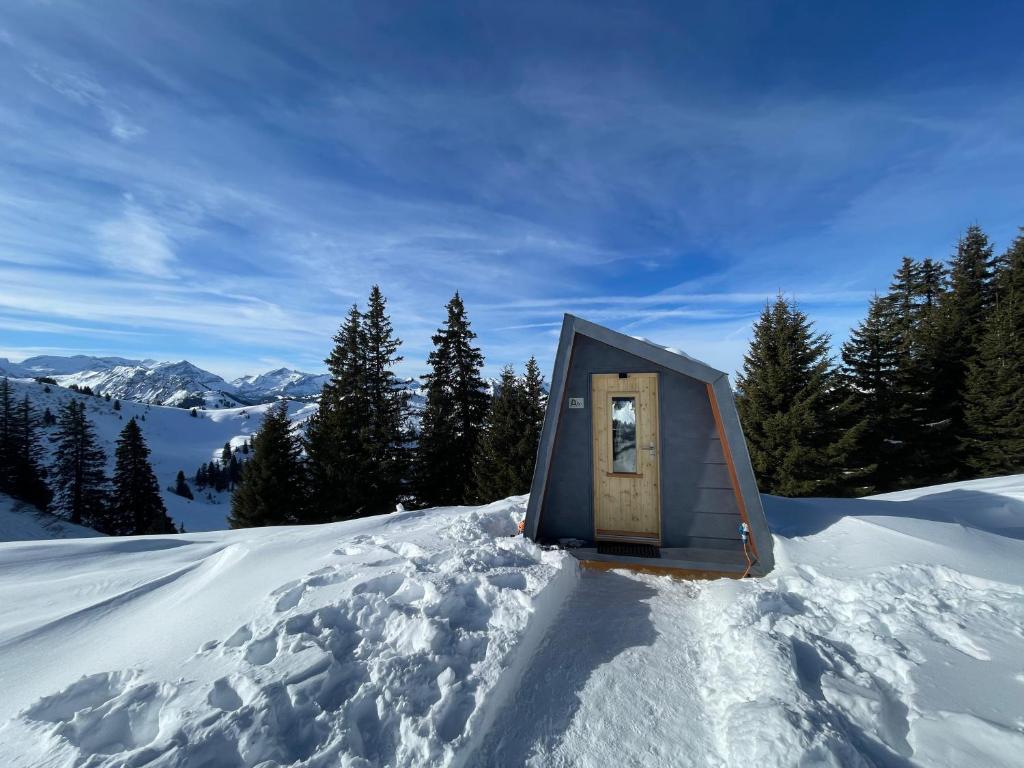
Iglu-Dorf, Gstaad, Switzerland.
Iglu-Dorf is an alpine reading of the format. Rather than one large building it is a village of linked igloos, built from packed snow at roughly two thousand metres above Gstaad and taken down by the melt. The domes are the structure, so the interiors are round, low and warmer in feel than a carved ice hall.
Altitude is the difference here. You arrive by lift rather than by road, which means the village sits above the treeline in a landscape of ski runs and peaks. The village opens onto that view directly, and the walk between domes happens outdoors in the snow.
Inside, the arrangement is familiar: insulated bags, hides, a temperature that holds a little below freezing, and a bar carved into the snow that does a good deal of the socialising. Some domes are carved as suites, others sleep several guests together, which makes it a more communal proposition than the Nordic hotels.
Among the six, this is the one closest to a night out in the mountains rather than a journey to the Arctic. It is also the easiest to reach from a European city, which is worth weighing against how much wilderness you actually want.
13
Hotel of Ice
Bâlea Lake, Romania · Ice Hotels
Built each winter since 2005 on a high glacial lake in Romania's Făgăraș mountains, reached by cable car.
Open
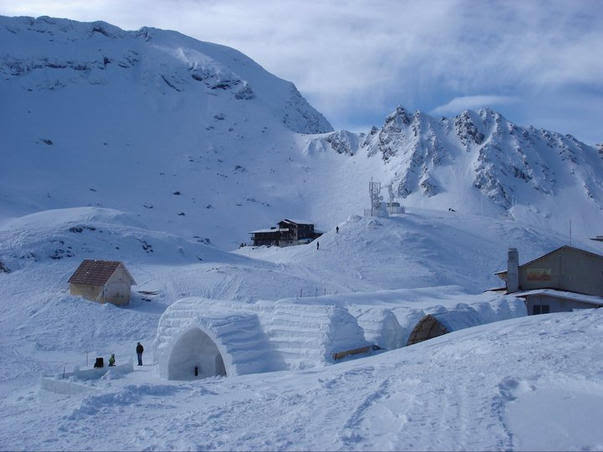
Hotel of Ice, Bâlea Lake, Romania.
The Hotel of Ice stands beside Bâlea Lake, a glacial lake high in the Făgăraș mountains of Romania, and has been rebuilt each winter since 2005. Blocks are cut from the frozen lake itself and used to build the walls, so the hotel is made from the water it sits on.
Access is part of the story. The road that reaches the lake in summer, the Transfăgărășan, closes under snow for months, so winter guests arrive by cable car from the valley. That single fact changes the feel of a stay: once you are up there, you are up there, and the weather decides the rest.
The building itself is modest by the standards of the section, a vaulted hall with rooms off it and a bar of carved ice, plus a small ice church that is rebuilt with the rest. Heated cabins nearby carry the facilities. Sleeping is on ice beds with hides and insulated bags, as everywhere here.
It is the least commercial of the six, and the most exposed. Cable cars stop in high wind, which is the practical risk you take on with it, and the mountains here are serious enough that the risk is not theoretical. Guests plan around the weather rather than the calendar.
14
Schneedorf Igloo
Ötztal, Austria · Ice Hotels
An Austrian snow village at around two thousand metres in the Ötztal, rebuilt from packed snow each winter.
Open
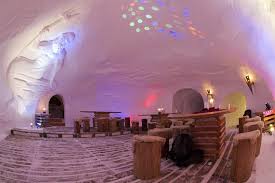
Schneedorf Igloo, Ötztal, Austria.
Schneedorf is the Austrian entry, a snow village built at about two thousand metres in the Ötztal valley and rebuilt every winter. The construction is packed snow shaped into domes and vaults, the same technique used in the Swiss village, applied to a larger and more spread-out plan.
The Ötztal is a working ski valley, so the hotel sits inside an existing mountain infrastructure of lifts, runs and villages rather than out on its own. Guests reach it by lift, walk in across the snow, and can be back down among restaurants and rooms with heating within the hour if the night turns out not to suit them.
Inside, the pattern of the section repeats: temperatures a few degrees below freezing whatever the valley is doing, insulated bags on ice or snow beds, hides for insulation, and a carved bar as the common room. Some domes are carved as private rooms and others are shared.
Read alongside Gstaad, this is the same idea in a different valley, and the two make a fair pair for anyone deciding which alpine version they want. Read alongside Kirkenes, it shows how much the latitude changes the experience. Two thousand metres in Tyrol and sea level in the Barents produce similar temperatures and entirely different nights.
New South Wales · 03
04
QT Sydney
Sydney CBD, NSW · Art Hotels
A hotel threaded through the State Theatre and the old Gowings department store on Market Street.
Open
QT Sydney, Sydney CBD, NSW.
Name and operator last checked August 2026
QT Sydney occupies two buildings that were never meant to be a hotel. One is the State Theatre, a 1929 picture palace of gilt and marble that still runs as a theatre. The other is the Gowings building, a department store that dressed Sydney men for the better part of a century. The hotel runs through both.
That history is the whole point. Corridors change direction because the two buildings never lined up, floor levels shift, and rooms sit in shapes that no architect would draw from scratch. Some look into the old store's light wells. The result is a hotel where the plan has to be discovered rather than understood at the door.
The interiors are deliberately theatrical, which suits a building that shares a wall with a working stage. There is a restaurant, a bar upstairs and a barber shop on the ground floor, all leaning into the same idea. Guests turn up for the rooms and stay downstairs longer than they planned.
Among the six art hotels here, this is the one where the art is the building itself rather than a named painter. It is also the most central: Market Street puts the Queen Victoria Building, the Pitt Street malls and the harbour within a short walk.
07
The Capsule Hotel
Sydney, NSW · Capsule Hotels
A central Sydney capsule hotel that sells a berth and shared bathrooms, and is honest about it.
Open
The Capsule Hotel, Sydney, NSW.
A capsule hotel sells a bed in a moulded berth, not a room, and this one does not pretend otherwise. Capsules are stacked along corridors, each closing with a screen or a door rather than a wall, with a light, a socket and enough headroom to sit up. Bathrooms are shared and down the hall.
The format came from Japan, where it solved a specific problem: a bed near a station for someone who missed a train. Sydney has borrowed the format for a different set of guests, mostly people who want a city-centre address for a night without the price of a room they will only sleep in.
What makes it worth listing is the discipline of the design. Everything is worked out to the centimetre, because there is no spare centimetre. Storage sits under or beside the berth, the corridors are narrow by design, and the common area does the work a lobby and a lounge would do in a larger hotel.
It is the smaller idea of the two hotels in this section, and the more traditional reading of the format. If you have stayed in a capsule in Osaka, you will recognise the plan immediately. What has changed in the crossing is the guest: fewer commuters, more travellers with a bag and an early flight.
08
The Pod Sydney
Sydney, NSW · Capsule Hotels
The second Sydney capsule hotel, a pod format for one night in the city between flights or trains.
Open
The Pod Sydney, Sydney, NSW.
The Pod Sydney takes the same starting point as its neighbour in this section and reads it slightly differently. The unit is a pod rather than a bunk: an enclosed sleeping space with its own light and power, arranged in rows, with bathrooms and a common area shared by the floor.
The appeal is location for a night. A capsule hotel earns its place by being in the middle of a city where a room costs what a room costs, and by asking guests to give up everything except the bed and the address. Everything the format removes is something you would not use between eleven at night and seven in the morning.
Because there are no windows in most capsules, the lighting inside does the work of morning and evening, and that is worth knowing if you sleep badly in the dark. Guests who need to work, spread out or keep unusual hours are better served elsewhere, and the hotel does not argue otherwise.
Two hotels is a short section. We would rather run a short section than pad it with hostels, which are a different format with different rules, and there are only a handful of true capsule hotels in Australia to describe.
Queensland · 01
02
Art Series — The Johnson
Spring Hill, Brisbane, QLD · Art Hotels
The Brisbane hotel in the Art Series group, given over to the bright abstract work of Michael Johnson.
Open
Art Series — The Johnson, Spring Hill, Brisbane, QLD.
The Johnson takes the same premise as the other Art Series hotels and hands it to Michael Johnson, an Australian abstract painter whose colour arrives at full strength. Where a hotel that leans on landscape photography stays polite, this one does not. The work is loud in the way abstraction can be loud, and the interiors are built to carry it.
The hotel sits in Spring Hill, on the rise just north of the Brisbane CBD. Spring Hill is a mixed suburb of old workers cottages, medical rooms and apartment blocks, and the hotel reads as part of that mix rather than as a landmark. The city centre is a walk downhill, which is easier in one direction than the other.
Rooms and apartments run to kitchen benches and laundry facilities, which tells you who stays here. This is a hotel for people in Brisbane for a week, not a night, and the art is there to keep a longer stay from turning into a serviced apartment with a view of a car park.
Read against The Olsen, the difference is temperature. Melbourne gets a painter of water and drought; Brisbane gets pure colour, in a city where the light is already doing most of the work outdoors.
South Australia · 01
03
Art Series — The Watson
Walkerville, Adelaide, SA · Art Hotels
An Adelaide hotel in the Art Series group, named for the Western Desert painter Tommy Watson.
Open
Art Series — The Watson, Walkerville, Adelaide, SA.
Name and operator last checked August 2026
The Watson is the Adelaide entry in the Art Series group, and it is named for Tommy Watson, a Pitjantjatjara painter from the Western Desert whose canvases work in dense, layered colour. Placing that work in a suburban hotel north of the Adelaide parklands is a decision, and the hotel is more interesting for having made it.
The address is Walkerville, which sits just beyond the parklands ring rather than in the city grid. Adelaide is small enough that this is not a problem, and the setting is quieter than a CBD hotel would be. The hotel is a tall modern block among low streets, so the upper floors look a long way out.
The format follows the group: apartment-style rooms with kitchen benches, reproductions and originals through the public spaces, and a bar and dining room on the ground floor. Guests who never intend to look at a painting still walk past several a day.
Within this section, The Watson is the one that most clearly tests the Art Series idea. The other five hotels build around European or urban Australian traditions. This one builds around desert painting, in a state where the desert starts a few hours up the road, and the pairing holds.
Tasmania · 01
06
Saffire Freycinet
Coles Bay, TAS · Art Hotels
A low Tasmanian lodge on Great Oyster Bay, facing the granite peaks of the Hazards across the water.
Open
Saffire Freycinet, Coles Bay, TAS.
Name and operator last checked August 2026
Saffire Freycinet is the only entry in this section that is not in a city, and the only one where the view does more work than the interior. The lodge sits above Great Oyster Bay at Coles Bay, on the east coast of Tasmania, looking across the water at the Hazards, the pink granite range that closes off the Freycinet peninsula.
The building answers that view rather than competing with it. It is long, low and curved, timber-lined, with the main pavilion given over to glass so the range is in front of you from most of the public rooms. Suites are separate and spread along the slope, so the lodge reads as a settlement rather than a block.
The reason it belongs in a section about art hotels is the same reason The Treasury does. The design here is the work being shown. Tasmanian timbers, a roofline drawn against the range, and a plan that keeps the bay in sight from almost everywhere are the argument the building makes.
It is also the hardest of the six to reach, and the most seasonal in feeling. That is worth knowing before you plan around it, because Coles Bay is a drive from anywhere with an airport.
Victoria · 01
01
Art Series — The Olsen
South Yarra, Melbourne, VIC · Art Hotels
An Art Series hotel in South Yarra named for the painter John Olsen, whose work fills it.
Open
Art Series — The Olsen, South Yarra, Melbourne, VIC.
The Olsen belongs to the Art Series group, and the idea behind that group is simple. Each hotel takes one Australian artist and builds itself around the work. Here the artist is John Olsen, a painter who spent a career on water, birds and the dry inland, and whose lines do not sit quietly on a wall.
The hotel stands on Chapel Street in South Yarra, which is a shopping street with trams down the middle and a long line of cafes. That matters more than it sounds. You walk out of a building hung with paintings and straight into the ordinary noise of Melbourne, and the two things sharpen each other.
Inside, the work is not confined to a gallery corner. Prints and originals run through the corridors and the rooms, so guests meet the collection on the way to the lift rather than by making a decision to look. Suites are the format the hotel is known for, many with kitchen benches and glass-fronted balconies.
Of the six hotels in this section, The Olsen is the most urban and the easiest to reach without planning. It is the one we would send a first-time visitor to, because the hotel explains its own premise within about a minute of arrival.
Western Australia · 01
05
COMO The Treasury
Perth, WA · Art Hotels
A hotel inside Perth's restored nineteenth-century State Buildings, where the colony once kept its treasury.
Open
COMO The Treasury, Perth, WA.
Name and operator last checked August 2026
The State Buildings on the corner of Barrack Street and St Georges Terrace were the administrative centre of the colony of Western Australia. The treasury sat here, along with the post office and the lands department. The buildings stood mostly empty for years before the restoration that turned part of them into this hotel.
What that gives the hotel is a plan it did not choose. Rooms are set behind the original windows, which are tall and unevenly spaced because they were cut for offices. Ceilings are high for the same reason. The corridors still run where the office corridors ran, and the stonework in the public rooms was left to look its age.
The ground floor was handed to restaurants, bars and a wine shop that anyone can walk into, so the building went back to being a place the city passes through rather than a lobby with a security desk. The hotel occupies the upper levels above that traffic.
This is our Western Australian entry, and it is the one nearest home. Perth does not have many nineteenth-century buildings left standing in use, which is a large part of why this hotel is in the section at all.
Austria · 01
14
Schneedorf Igloo
Ötztal, Austria · Ice Hotels
An Austrian snow village at around two thousand metres in the Ötztal, rebuilt from packed snow each winter.
Open
Schneedorf Igloo, Ötztal, Austria.
Schneedorf is the Austrian entry, a snow village built at about two thousand metres in the Ötztal valley and rebuilt every winter. The construction is packed snow shaped into domes and vaults, the same technique used in the Swiss village, applied to a larger and more spread-out plan.
The Ötztal is a working ski valley, so the hotel sits inside an existing mountain infrastructure of lifts, runs and villages rather than out on its own. Guests reach it by lift, walk in across the snow, and can be back down among restaurants and rooms with heating within the hour if the night turns out not to suit them.
Inside, the pattern of the section repeats: temperatures a few degrees below freezing whatever the valley is doing, insulated bags on ice or snow beds, hides for insulation, and a carved bar as the common room. Some domes are carved as private rooms and others are shared.
Read alongside Gstaad, this is the same idea in a different valley, and the two make a fair pair for anyone deciding which alpine version they want. Read alongside Kirkenes, it shows how much the latitude changes the experience. Two thousand metres in Tyrol and sea level in the Barents produce similar temperatures and entirely different nights.
Canada · 05
10
Hôtel de Glace
Québec City, Canada · Ice Hotels
North America's ice hotel, redesigned and rebuilt from snow near Québec City every winter since 2001.
Open
Hôtel de Glace, Québec City, Canada.
Hôtel de Glace opened in 2001 and is the ice hotel of North America. Like its Swedish predecessor it is built for a single season, but the emphasis here falls on snow rather than clear ice. Thick vaulted walls are formed over moulds, which gives the interiors their heavy, tunnelled feeling.
Every year the plan is drawn again. Rooms, corridors, the chapel and the bar move, and the carving that lines them is new work rather than a repeat of last winter. Guests who return find a building they have not been in before, standing on the same ground near Québec City.
The practical arrangement follows the pattern of the section. The ice building holds close to freezing whatever the weather does outside, sleeping is done in insulated bags on ice beds, and heated buildings nearby carry the bathrooms and the parts of a stay that cannot happen at minus five.
What sets it apart from Jukkasjärvi is proximity. This one sits within reach of a major city with an international airport, which makes it the most straightforward ice hotel in this section to add to an existing trip. Québec City in winter is a reason to travel on its own, and the ice hotel sits at the end of a short drive rather than at the end of a journey north.
15
Montreal Casino & Hotel
Île Notre-Dame, Montréal, Québec · Casino Hotels
A hotel and casino in the sculptural Expo 67 pavilions on an island in the St Lawrence River.
Open
Montreal Casino & Hotel, Île Notre-Dame, Montréal, Québec.
This one exists because of a world's fair. The buildings on Île Notre-Dame were the French and Québec pavilions of Expo 67, and they were designed to be looked at: angular, layered, more sculpture than shed. Rather than being demolished when the fair closed, they were kept and eventually converted.
The conversion is the interesting part. A pavilion built to move crowds through in twenty minutes had to become a building people stay inside for an evening, and the levels stacked inside the original volume are what came of that. You move up and down through the building far more than you move across it.
There are restaurants with a serious kitchen behind them, and a regular programme of live music through the year. The upper levels look back across the water at the Montréal skyline, which is the view the pavilions were given in the first place.
The setting is a park island in the St Lawrence, shared with the rowing basin and the racing circuit left over from the same era. It is green, flat and open, and it feels a long way from a downtown hotel even though the city is directly in front of you. Few hotels anywhere have a stranger origin, and fewer still have kept the shape of the building they started as.
16
Fallsview Casino Resort
Niagara Falls, Ontario · Casino Hotels
An early two-thousands resort set on the cliff above the falls, with rooms and restaurants facing the water.
Open
Fallsview Casino Resort, Niagara Falls, Ontario.
Fallsview opened in the early two-thousands on the escarpment directly above Niagara Falls, and the site is the whole design argument. The building is cut into the cliff, so what would be a basement anywhere else opens onto the gorge, and the public rooms are arranged along the side that faces the water.
That produces a hotel with a strong front and a plain back. Restaurants and lounges take the view, guest rooms above them are graded by whether they face the falls or the town behind, and the interior circulation runs parallel to the cliff rather than around a courtyard. It is a simple plan carried out at large scale.
The resort carries a theatre that books touring names through the year, a spa, and a range of restaurants from casual rooms to full dining. In practice it works as the indoor half of a Niagara stay, with the falls and the parkland doing the other half a few minutes downhill.
Niagara Falls is a tourist town and does not hide it. The resort belongs to that town rather than standing apart from it, and it is the busiest of the four hotels in this section. Anyone hoping for a quiet weekend is better served by the other three.
17
River Rock Casino Resort
Richmond, British Columbia · Casino Hotels
A waterfront resort in Richmond outside Vancouver, with its own marina, a show theatre and a spa.
Open
River Rock Casino Resort, Richmond, British Columbia.
River Rock sits on the water at Richmond, on the arm of the Fraser River that runs out past Vancouver's airport. The resort has its own marina, which is unusual for a hotel of this kind, and the waterfront frontage gives it a horizontal, low-slung shape rather than a tower.
Richmond matters to the description. It is a city in its own right, with one of the strongest concentrations of Chinese and other Asian restaurants in North America, and the resort sits inside that food culture rather than importing one. Guests who eat out are better served in the surrounding blocks than in most hotel districts.
The resort carries a show theatre used for touring music and comedy, a spa, and several restaurants across the site. The rooms above are ordinary in the good sense: quiet, generous and largely given over to the view across the water and the flats.
The airport is close, which is convenient and audible. This is the most urban of the four hotels in this section, and the one where the surrounding city gives you the most reason to leave the building. It is also the simplest to work into the start or the end of a trip, since the rail link runs from the terminal to the door in minutes.
18
Casino Rama Resort
Rama, Ontario · Casino Hotels
A lakeside Ontario resort on Chippewas of Rama First Nation land, with a large concert hall and golf.
Open
Casino Rama Resort, Rama, Ontario.
Casino Rama stands on the lands of the Chippewas of Rama First Nation, beside Lake Couchiching in central Ontario. That ownership is the first thing to say about it, because the resort was developed on and for those lands, and it is the reason a building of this size sits in a rural township rather than in a city.
The site is lake country. Couchiching and Simcoe are cottage lakes, and the landscape around the resort is water, low bush and golf rather than streets. The buildings spread horizontally across the ground, with the accommodation set apart from the entertainment side.
The concert hall is the part that draws people from a distance. It is large, it books touring acts through the year, and a night there is what fills the rooms upstairs. Alongside it are restaurants across several formats and a spa, arranged so that the resort works as a self-contained weekend.
Of the four hotels in this section, this is the one most tied to its landscape and the least tied to a city. It is also the one where the drive is part of the plan rather than an inconvenience. The route north out of Toronto through the lakes is the beginning of the stay, not a delay before it.
Norway · 01
11
Kirkenes Snowhotel
Kirkenes, Norway · Ice Hotels
A snow hotel in Norway's far north-east, near the Russian border, running each winter since 2006.
Open
Kirkenes Snowhotel, Kirkenes, Norway.
Kirkenes sits at the top of Norway, closer to Murmansk than to Oslo, and the Snowhotel has been rebuilt there each winter since 2006. Of the six in this section it is the one furthest from an easy connection, and that remoteness is a large part of what it is selling.
The building is snow and ice, with carved rooms off a central corridor, held a few degrees below freezing throughout. Sleeping bags and hides do the work that heating cannot. Cabins with heat and bathrooms sit beside it, which is how nearly every hotel in this section is arranged.
The setting is what distinguishes it. This is a working corner of the Barents region rather than a resort valley: a fjord, a border, a port and a small town. The hotel runs husky and reindeer operations on the same site, and the darkness of the polar night is a genuine condition rather than an atmosphere.
Put beside Gstaad or Ötztal, this is the least alpine and the most northern of the six. If the appeal for you is latitude rather than altitude, it is the one to read closely. Getting here takes a day and at least one connection, and the town at the end of it is small, so the trip is the commitment rather than the night in the snow.
Romania · 01
13
Hotel of Ice
Bâlea Lake, Romania · Ice Hotels
Built each winter since 2005 on a high glacial lake in Romania's Făgăraș mountains, reached by cable car.
Open
Hotel of Ice, Bâlea Lake, Romania.
The Hotel of Ice stands beside Bâlea Lake, a glacial lake high in the Făgăraș mountains of Romania, and has been rebuilt each winter since 2005. Blocks are cut from the frozen lake itself and used to build the walls, so the hotel is made from the water it sits on.
Access is part of the story. The road that reaches the lake in summer, the Transfăgărășan, closes under snow for months, so winter guests arrive by cable car from the valley. That single fact changes the feel of a stay: once you are up there, you are up there, and the weather decides the rest.
The building itself is modest by the standards of the section, a vaulted hall with rooms off it and a bar of carved ice, plus a small ice church that is rebuilt with the rest. Heated cabins nearby carry the facilities. Sleeping is on ice beds with hides and insulated bags, as everywhere here.
It is the least commercial of the six, and the most exposed. Cable cars stop in high wind, which is the practical risk you take on with it, and the mountains here are serious enough that the risk is not theoretical. Guests plan around the weather rather than the calendar.
Sweden · 01
09
Icehotel
Jukkasjärvi, Sweden · Ice Hotels
The first of them, built new from the Torne river every winter in Swedish Lapland since 1989.
Open
Icehotel, Jukkasjärvi, Sweden.
Icehotel began in 1989 in Jukkasjärvi, a village in Swedish Lapland north of the Arctic Circle, and every ice hotel that followed is answering it. The hotel is built each winter from ice cut out of the Torne river and from snow sprayed over steel forms, and each spring the river takes the material back.
That cycle is the design brief. Nothing is meant to survive, so nothing is designed to. Artists are invited to work on the individual suites, which means the hotel is a different building each year, with a different plan, different rooms and different carving. Photographs of one winter describe that winter only.
Sleeping in it is a specific experience rather than a comfortable one. The interior holds a few degrees below freezing regardless of the weather outside, guests sleep on ice beds under reindeer hides in insulated bags, and warm accommodation with proper bathrooms sits alongside for the rest of the stay.
Of the six hotels in this section, this is the one to read first. It set the pattern the others work within: cut, build, open for a season, and lose the whole thing to the thaw. Every hotel that came afterwards has had to decide how closely to follow that pattern.
Switzerland · 01
12
Iglu-Dorf
Gstaad, Switzerland · Ice Hotels
An igloo village rebuilt each winter at about two thousand metres above Gstaad in the Swiss Alps.
Open
Iglu-Dorf, Gstaad, Switzerland.
Iglu-Dorf is an alpine reading of the format. Rather than one large building it is a village of linked igloos, built from packed snow at roughly two thousand metres above Gstaad and taken down by the melt. The domes are the structure, so the interiors are round, low and warmer in feel than a carved ice hall.
Altitude is the difference here. You arrive by lift rather than by road, which means the village sits above the treeline in a landscape of ski runs and peaks. The village opens onto that view directly, and the walk between domes happens outdoors in the snow.
Inside, the arrangement is familiar: insulated bags, hides, a temperature that holds a little below freezing, and a bar carved into the snow that does a good deal of the socialising. Some domes are carved as suites, others sleep several guests together, which makes it a more communal proposition than the Nordic hotels.
Among the six, this is the one closest to a night out in the mountains rather than a journey to the Arctic. It is also the easiest to reach from a European city, which is worth weighing against how much wilderness you actually want.
Details change. Everything here is accurate to the best of our knowledge as at August 2026. All hotel names belong to their owners; we have no commercial relationship with any of them.
On paper
The print sheet puts all eighteen on a single table made for a printer rather than a screen.